
Regenerative medicine
Harnessing biology to explore new approaches to tissue repair and recovery.
What is regenerative medicine ?
Regenerative medicine is a multidisciplinary field that investigates how damaged or diseased cells, tissues and organs may be repaired, replaced or supported in recovering their function. It brings together expertise from cell biology, bioengineering, biomaterials science and clinical medicine.1,2
Rather than representing one specific treatment, regenerative medicine encompasses a range of scientific strategies. These include approaches that aim to stimulate the body’s own repair mechanisms, deliver biological signals, introduce cells, or create supportive environments in which tissue repair may occur.1,2
Development of Clinical Applications
Research and, in some cases, clinical practice in this field includes:
- Autologous biological preparations, derived from a patient’s own blood (e.g. Platelet-Rich Plasma or PRP) or tissues
- Cell-based approaches, including the study of stem cells
Biomaterials and scaffolds, designed to provide structural or biological support - Gene-based technologies, intended to modify cellular function or address specific biological pathways
The level of scientific and clinical evidence varies considerably between technologies, indications and individual products. Some approaches are established in specific medical settings, while others remain under preclinical or clinical investigation.3
Medical/Clinical applications
Musculoskeletal tissues differ considerably in their structure, vascularisation and capacity for spontaneous repair. Cartilage, tendon, ligament, muscle and bone therefore require different research and therapeutic strategies. Regenerative-medicine research and application in musculoskeletal care includes the investigation of orthobiologics, cell-based approaches, tissue-engineered scaffolds and combinations of biological and physical technologies.6
Mechanism of Action
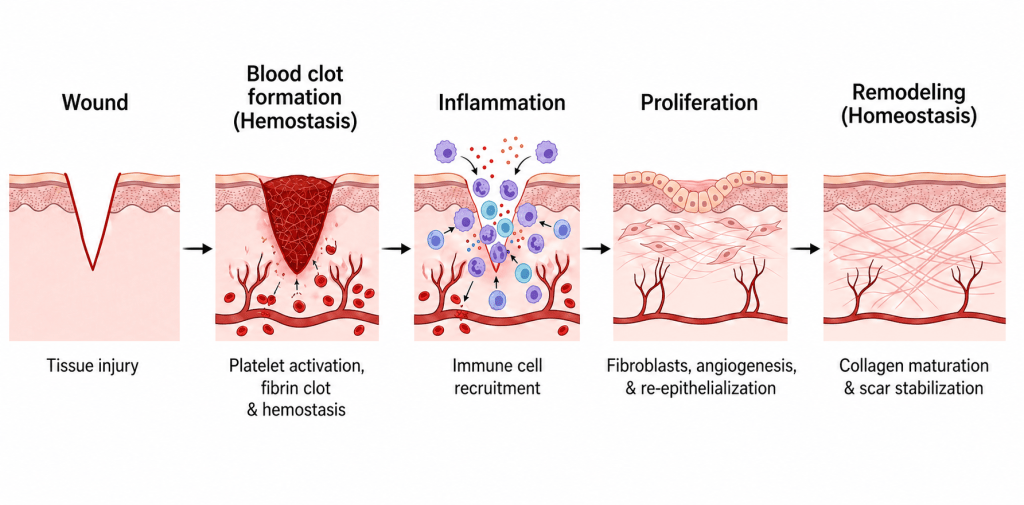
Tissue repair is a coordinated biological process involving inflammation, cell recruitment, proliferation, extracellular matrix production and tissue remodelling. Regenerative medicine seeks to understand and, where appropriate, influence one or more stages of this process (figure 1).1,2
Depending on the technology being studied, a regenerative approach may aim to:
- Provide biological signals involved in cellular communication
- Support cell migration, survival or activity
- Influence the local inflammatory environment
- Create a temporary framework for tissue organisation
- Support the formation or remodelling of extracellular matrix
- Replace or supplement damaged cells
- Restore aspects of tissue structure or function
Figure 1: Wound healing phases
These mechanisms are complex and depend on factors such as the tissue involved, the nature and duration of the injury, the patient’s health, and the composition, preparation and delivery of the therapy. For this reason, biological activity observed in laboratory models does not automatically demonstrate clinical tissue regeneration. Clinical studies are required to establish the safety, performance and potential benefits of each approach in a defined medical indication.3,4

Musculoskeletal disorders
Osteoarthritis and cartilage
Current clinical investigations are examining whether biological preparations (e.g. Platelet-Rich Plasma or PRP.), cells, biomaterials or combination approaches can influence the joint environment, symptoms or tissue-related outcomes in osteoarthritis. The distinction between symptom improvement and structural regeneration is essential. A reduction in pain or improvement in function does not by itself demonstrate that cartilage has been restored.
Tendons and ligaments
Tendons and ligaments have highly organised cells and matrices and, in some regions, relatively limited vascularity. Regenerative research is investigating approaches that may influence the biological environment associated with healing, matrix organisation and functional recovery.
Muscle injuries
Research in muscle injury includes biological signalling, scaffolds and rehabilitation-associated approaches. The interaction between a biological intervention, mechanical loading and rehabilitation may be particularly relevant to improve the healing process and finally improve the functional recovery.
Bone and osteochondral defects
Bone has intrinsic regenerative capacity, but healing may be difficult in large, complex or poorly vascularised defects. Biomaterial scaffolds, growth-factor delivery systems and cell-based technologies are being studied as potential ways to support bone and osteochondral repair.2˒6

Ophthalmology
Ocular surface
Research includes:
- Cultivation and transplantation of limbal epithelial cells
Corneal endothelial-cell therapies - Biomaterial and tissue-engineered corneal substitutes
- Blood-derived preparations for selected ocular-surface applications
- Biological approaches to epithelial healing and ocular-surface homeostasis
Some cell-based ocular-surface approaches have reached clinical use in defined settings (e.g. tissue-engineered product to treat limbal stem-cell deficiency), while other technologies remain experimental.
Retina and retinal pigment epithelium
Cell and gene-based strategies are being investigated for retinal degenerative conditions, including age-related macular degeneration and inherited retinal diseases. Research includes the replacement or support of photoreceptors and retinal pigment epithelial cells, as well as modification of disease-related pathways.5, 7
These approaches are biologically and technically complex. Major considerations include cell survival, integration, immune response, delivery, long-term safety and the ability to demonstrate meaningful visual benefit.
Dry eye and ocular-surface disease
Regenerative research in ocular-surface disease includes biological tear substitutes, autologous blood-derived products, cell-based approaches and extracellular vesicles. The intent of these studies may include supporting epithelial recovery, tear-film homeostasis or the local ocular-surface environment.
Evidence before expectation
Regenerative medicine has significant scientific potential, but it is also associated with considerable public interest and sometimes exaggerated expectations.
- Regulatory status: Is the specific product authorised for the proposed medical use?
- Biological characterisation: What exactly does the preparation contain?
- Manufacturing consistency: Can the preparation be reproducible?
- Mechanism: Is the proposed biological mechanism supported by appropriate published evidence?
- Clinical outcomes: Have safety and patient-relevant outcomes been evaluated?
- Duration: Are potential outcomes maintained over an appropriate follow-up period?
- Structural evidence: Does the research demonstrate tissue change, or only symptomatic improvement?
- Comparison: Has the approach been compared with placebo, standard care or another relevant intervention?
Regulatory authorities have warned about the marketing of unapproved stem-cell, stromal-vascular-fraction, birth-tissue and exosome products. Reported safety concerns associated with unapproved products have included infection, tumour formation and loss of vision.³
Related products

Therapeutic areas
At the intersection of innovation and care, our integrated therapeutic approach supports patients across three vital domains
References
-
National Institutes of Health. Regenerative Medicine. NIH regenerative medicine overview. Accessed 21-Aug-2026.
-
Sampogna G, Guraya SY, Forgione A. Regenerative medicine: Historical roots and potential strategies in modern medicine. J Microsc Ultrastruct. 2015;3(3):101-107.
-
US Food and Drug Administration. Important Patient and Consumer Information About Regenerative Medicine Therapies. FDA information on regenerative-medicine therapies. Accessed 21-Aug-2026.
-
Obaid A, Burianek A, Marshall A, Smith A, Hickey B. Platelet-rich plasma and stem cell therapies for musculoskeletal rehabilitation: current evidence on dosing, activation, and functional performance. Orthop Rev. 2026;18:160607.
-
Santa Cruz-Pavlovich FJ, Bolaños-Chang AJ, Del Rio-Murillo XI, Aranda-Preciado GA, Razura-Ruiz EM, Santos A, Navarro-Partida J. Beyond vision: an overview of regenerative medicine and its current applications in ophthalmological care. Cells. 2024;13(2):179.
-
Ganguly P. Intersection of artificial intelligence and regenerative medicine in musculoskeletal diseases: a narrative review. Appl Biosci. 2026;5(1):22.
-
Van Gelder RN, Chiang MF, Dyer MA, Greenwell TN, Levin LA, Wong RO, Svendsen CN. Regenerative and restorative medicine for eye disease. Nat Med. 2022;28(6):1149-1156.